
How a Mid-Block Controls the Game Without the Ball
Explains the compactness of a mid-block, how it closes central passing lanes, and its outlets for counter-attacks.
Sources checked 2026-09-22
Where to allow the opponent to play
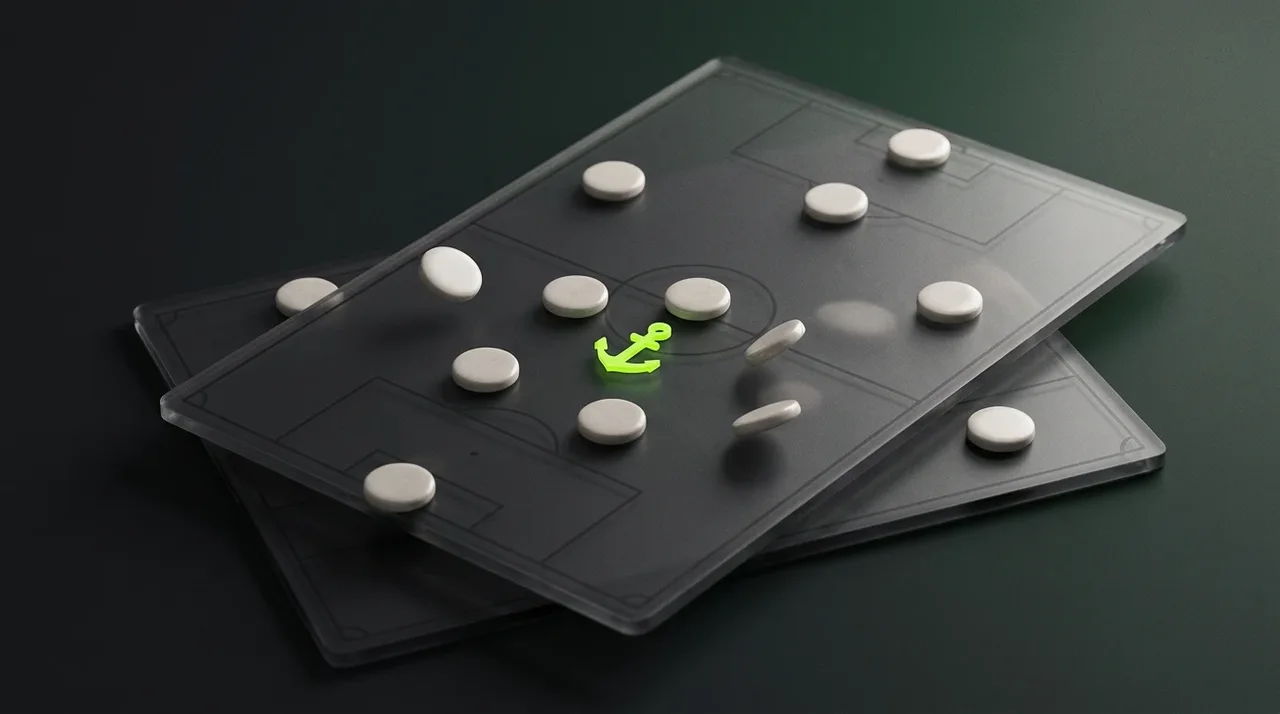
A mid-block is a compact defensive organisation based around the middle third. It may allow the opponent's defenders to pass the ball among themselves, but it aims to prevent easy entry into central midfield. The team without the ball should not be seen as doing nothing and waiting. By choosing where to let the ball go, it may be shaping the opponent's path.
The closeness between the lines is key. Even if the front line drops deep, if the back line is too low, space opens between the midfield and defence to receive the ball. To reduce that distance, the whole team must shift toward the ball. When the nearest player presses the ball, if a teammate does not cover the space left behind, compactness can break down.
Closing inside and funneling wide
If the central lane is protected, the opponent will likely choose to pass wide. At that moment, the wide midfielder can press while the holding player covers the inside return path. The full-back must decide whether to step up or track the runner in behind. The coordinated movement of nearby players matters more than one individual's speed.
If the opponent can switch play quickly from side to side, it tests the mid-block's lateral shifting. If the far-side winger is too narrow, the distance to close down when the ball arrives increases. If too wide, a gap can open centrally. Therefore, compactness is not always the same width; it must be adjusted according to the ball's position, the time available to deliver it, and the opponent's choices.
Plan after winning the ball back
Winning the ball in midfield allows a team to start an attack without being too far from the opponent's goal. However, if the front line has dropped too deep in the defensive shape, there may be no immediate outlet forward. The ball-winner needs a nearby passing option, a runner further ahead and defensive cover behind. If the counter-attacking lane is not open, keeping the ball and regrouping may also be appropriate.
When evaluating this system, do not judge it solely by the opponent's possession share. Observe whether they are circulating the ball far from goal or receiving freely between the lines. Also look at whether your team can regain the ball and escape pressure. By combining these observations, it becomes clearer whether the mid-block is providing control or just absorbing pressure.
Further points to study when watching matches
If an opponent's central defender can carry the ball into midfield without pressure, the mid-block is forced to make a new decision: does the forward track back to apply pressure, does a midfielder step out, or does the whole back line drop slightly? If one player steps out, a nearby teammate must close the inside lane. The aim is not to preserve a fixed shape at all costs, but to maintain coordination whenever it changes.
While watching, note whether a defender has to step out every time an opponent midfielder enters between the lines. If so, the midfield line may not be sufficiently blocking the pass. But do not immediately blame that single defender. Consider the pressure from the front, the distances in midfield, and the quality of the opponent's passing. In team defending, it is important not to pin the problem solely on the last visible player.
Source: FIFA Training Centre ↗
Explore more stories